Why are magnets often depicted as a horseshoe?
When most people picture a magnet, they automatically think of a horseshoe shape with two poles.
This is precisely how a magnet is most often depicted, with this shape having become its hallmark. However, the horseshoe magnet is not merely a symbol – its distinctive shape also has practical significance.
From natural magnets to technical solutions
Magnetism was already known in ancient times thanks to magnetite – a naturally occurring mineral that attracts iron.
Researching magnetism did not really take off however until the 19th century when scientists discovered the connection between electricity and the magnetic field, and began to study it systematically.
A breakthrough occurred in 1825, when British inventor William Sturgeon introduced one of the first practical electromagnets.
He used an iron core bent into a U-shape, around which he wound a current-carrying wire. This electromagnet could hold roughly twenty times its own weight.
But the shape was not his idea – the horseshoe design had already been applied in the 18th century to permanent magnets,
since it enabled both poles to grasp an object simultaneously, thus multiplying the attractive force.
Sturgeon applied this proven shape to the new concept of an electromagnet.
Horseshoe magnets were subsequently used in numerous experiments and devices, and later also in the teaching of magnetism.
How does a magnet work?
A magnet exerts an effect thanks to the magnetic field generated in its vicinity.
This field is not distributed uniformly—there are two regions on the magnet where its effect is strongest.
These regions are called the north and south poles.
What matters, however, is not the names of the poles themselves, but the fact that the magnetic field has direction and shape.
This shape changes depending on how the magnet is constructed.
When opposite poles are close together, the field between them is more concentrated and can be better used in practice.
For this reason, the shape of the magnet plays a significant role in how strongly and where the magnet acts.
Of all shapes, why a horseshoe?
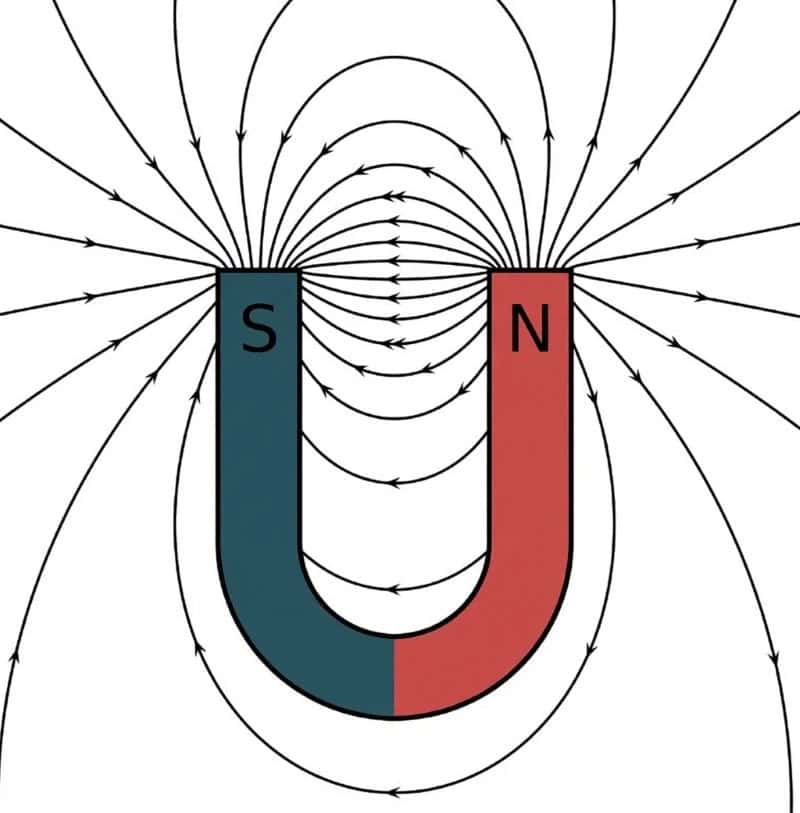
A horseshoe magnet has one fundamental advantage: both poles lie next to each other on the same side of the magnet, separated only by the gap between the arms.
The magnetic field thus does not merely spread diffusely into the surrounding area, but concentrates primarily at the ends of the arms of
the horseshoe and in the space between them.
Therefore, a horseshoe magnet attracts objects primarily with the ends of its arms – and the horseshoe’s arch hardly attracts them at all.
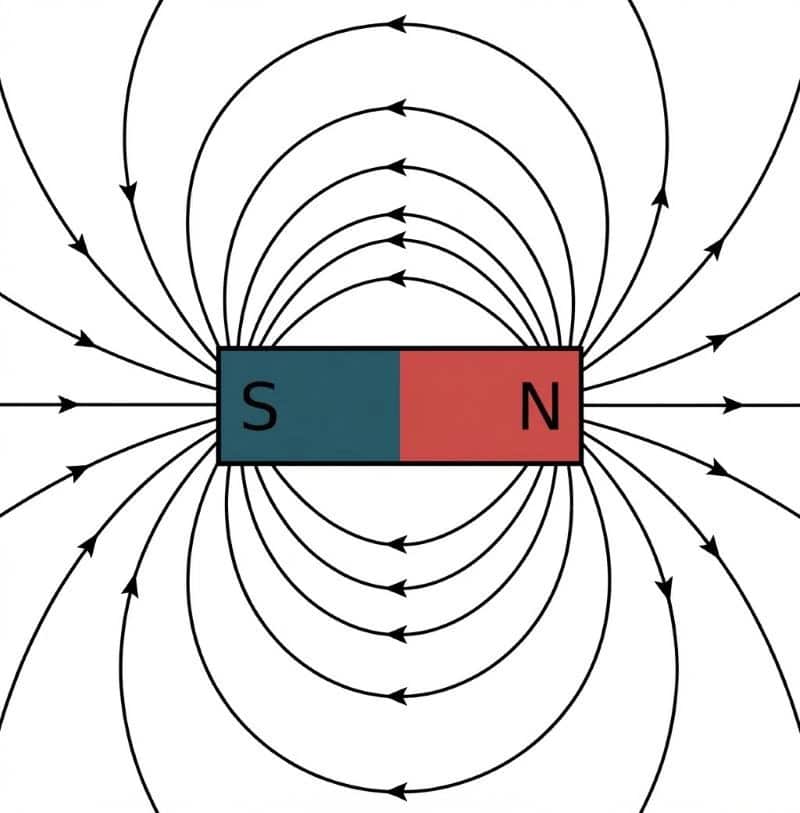
The difference between a bar magnet and a horseshoe magnet is best illustrated by comparing the locations of their poles and how the magnetic field is used as a result.
| Property | Bar magnet | Horseshoe magnet |
|---|---|---|
| Position of the poles | On opposite ends of the magnet | The poles are adjacent on the same side, separated by a gap between the arms |
| Action on the object | Usually, mainly one pole acts on the object | The object may touch both poles at once |
| Magnetic field | The field extends around two distant poles | The field is concentrated primarily at the ends of the arms and in the gap between them |
| Use of magnetic force | The two poles are far apart, so they cannot easily be used at the same point | Both poles can act on the same object simultaneously, allowing for more effective use of the magnetic force |
When a ferromagnetic object touches both poles of a horseshoe magnet simultaneously, it creates a path between them that allows the magnetic flux to close more easily.
The magnetic circuit closes more effectively, and the attractive force can be significantly higher than when using only a single pole.
The same concept was also applied to the first electromagnets:
the U-shaped core brought both poles close together, allowing them to act jointly on the same object—for example, an iron plate placed against the ends of the arms.
-
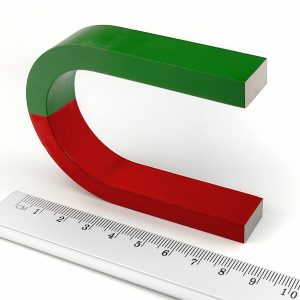 School magnet – horseshoe
From 1 pcs: 18,69€ From 2 pcs: 17,69€ -
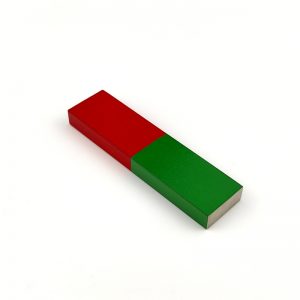 School magnet – block
From 1 pcs: 6,99€ From 2 pcs: 6,49€
Magnet stability and historical reasons for the shape
Older permanent magnets were generally more susceptible to demagnetization than many of today’s magnetic materials.
Thus, the magnet’s shape was not just a question of performance, but also stability.
The horseshoe magnet made it possible to:
- close the magnetic field by a shorter path,
- reduce the internal weakening of the magnet,
- extend its service life.
That is because the shape of the magnet has a significant influence on how easily the magnet gradually weakens on its own – this applies especially to older materials such as steel or AlNiCo.
For this reason, horseshoe magnets were often stored with an iron bridge (known as a keeper) that connected the poles and protected the magnet when not in use.
An iron bridge between the poles helped close the magnetic circuit and limit the loss of magnetization.
Why is the horseshoe still used as a symbol today?
Modern magnets – for example neodymium – need not have a horseshoe shape to be strong and stable.
Despite this, this shape has become the universal symbol of a magnet.
There are several reasons:
- it is easily understood even by laypeople,
- it has strong historical continuity,
- it is perfect for explaining the principles of the magnetic field.
That is why the horseshoe magnet is still used today as a basic visual representation of magnetism,
although in practice there are many other magnet shapes.

Why is a horseshoe magnet used in school?
The horseshoe-shaped magnet is not a random symbol.
It emerged as a practical solution to physical limitations,
played a significant role in the development of electromagnetism, and became a fundamental tool for teaching magnetism.
Its geometry is another advantage in teaching.
The north and south poles are close to each other, and the space between them is clearly visible,
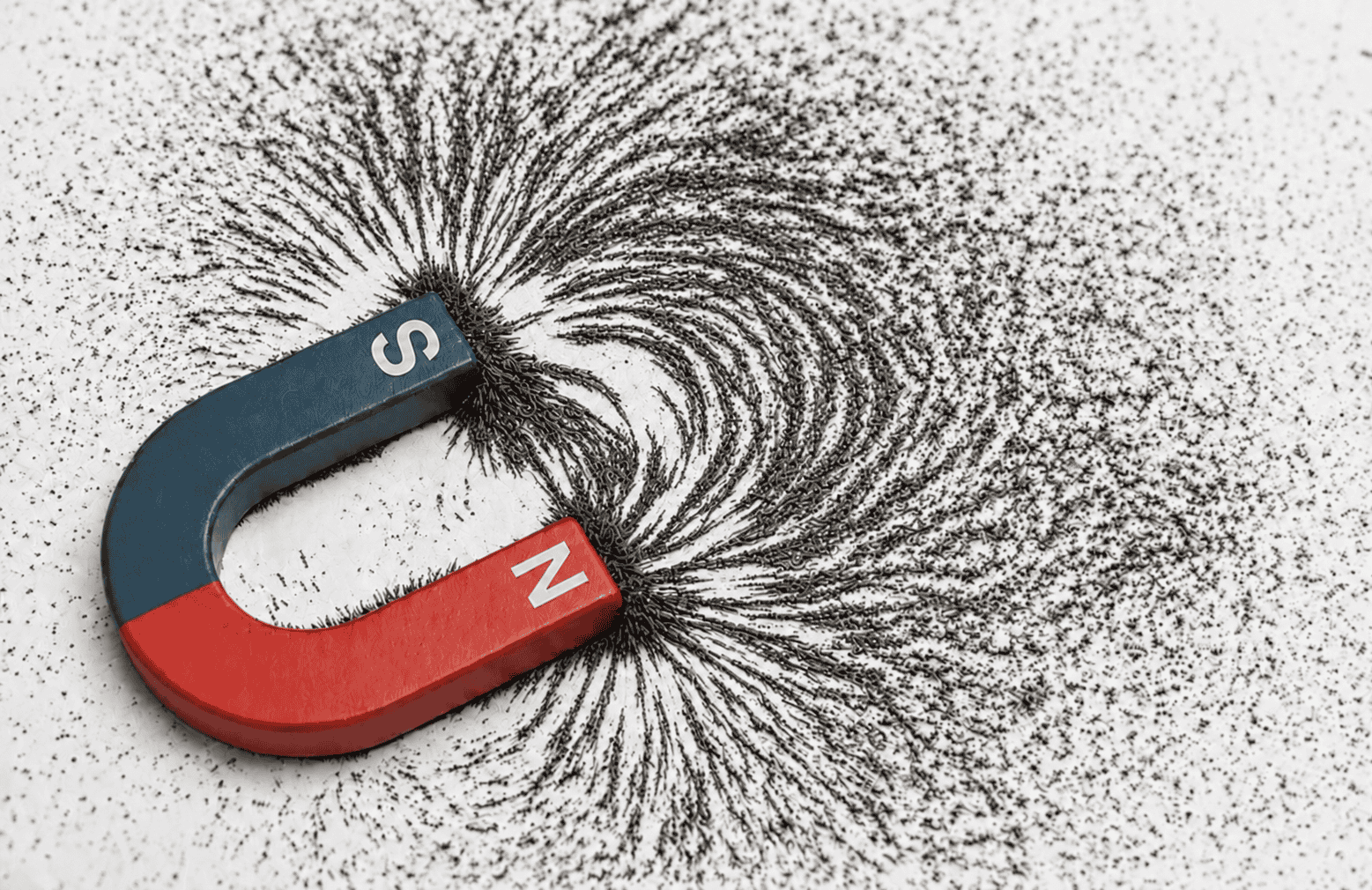
so the field pattern can be clearly demonstrated, for example with iron filings.
Even though modern technologies have brought new materials and designs,
the horseshoe remains one of the clearest and most iconic images of a magnet.
That is also why we commonly encounter it today—the horseshoe magnet is sometimes referred to as a ‘school magnet‘.
Not because it is outdated, but because its shape is exceptionally well-suited for illustrative experiments.
It remains popular in school laboratories and physics lessons, primarily due to its
clarity, reliability, and the intuitive understanding of magnetism in practice that it offers.
Key takeaways?
The horseshoe shape of a magnet is not just a graphic symbol.
Bringing the north and south poles closer together makes it possible to concentrate the magnetic field into a smaller space
and make practical use of both poles at once.
The shape of a magnet influences where its magnetic field is concentrated and how effectively it can be used.
Today, magnets come as rings, cylinders, blocks and cubes, as well as powerful magnets for
magnet fishing.
However, the horseshoe magnet remains one of the best ways to simply demonstrate the principles of magnetic poles and magnetic fields.
Sources
-
Coey, J. M. D. – History of Magnetism
-
National High Magnetic Field Laboratory – History of Electricity and Magnetism: 1820–1829
-
OpenStax – Physics: Magnetic Fields, Field Lines, and Force
-
University of Iowa, Department of Physics and Astronomy –
Magnet and Iron Filings